Tuesday, July 31, 2012

Who is Henry Galt? Book Review: The Driver by Garet Garrett

The Driver by Garet Garrett
Photo source: Mises.org
Garet Garrett’s 1922 novel The Driver is about railroads. The line “Who is Henry Galt?” appears twice. As a result, there seems to be a rule that if you write a book review about it, you have to include a discussion of the similarities to Ayn Rand’s Atlas Shrugged, with due aspersions cast on her originality. But since that’s been done in many other places, I’m going to make two other points instead.

But first, a plot summary. The Driver begins amid the economic Panic of 1893. While everyone else is convinced the country is bankrupt, Wall Street speculator Henry Galt is certain it’s rich. He takes advantage of the crisis to buy up shares of the Great Midwestern Railroad at bargain prices. Making himself chairman, he cuts costs, reforms a corrupt procurement system, and takes over other railroads. The resulting powerhouse makes Galt spectacularly wealthy and breathes new life into the American economy. But the pugnacious Galt makes enemies along the way. Unable to defeat him on the level playing field of the market, they turn to the government to take him down.

Now my two points.

The first is what the book tells us about the intellectual bankruptcy of the left. There was no Occupy Wall Street in 1893, but there was Coxey’s Army, a battalion of the unemployed that marched on Washington to demand what today we erroneously call “stimulus.” Here’s the narrator’s summary of his discussion with the marchers: “They blamed the money power in Wall Street. When they were asked how the money owner could profit by their unemployment, what motive it could have in creating hard times, they took refuge in meaningless phrases.” Sound familiar? In spite of a century of events that proved them wrong time after time, liberals still uses the same tired “arguments”. No new ideas in 100 years.

The second point is that it was a pleasure to read a story about an unapologetic businessman. Dragged in front of a congressional committee to defend himself against the antitrust and insider trading charges that his enemies brought against him, Galt said, “I made [my money] buying things nobody else wanted. I bought Great Midwestern when it was bankrupt and people thought no railroad was worth its weight as junk. When I took charge of the property I bought equipment when it was cheap because nobody else wanted it and the equipment makers were hungry, and rails and ties and materials and labor to improve the road with, until everybody thought I was crazy. When the business came we had a railroad to handle it. I’ve done that same thing with every property I have taken up. No railroad I’ve ever touched has depreciated in value.”

There are days when I can’t believe that, in spite of the unprecedented prosperity capitalism has brought us, we’re in the middle of a national debate over whether to continue to be capitalist. I’m astounded that the president of the United States can give a speech in which he demonstrates astonishing ignorance of what businesspeople do – as Obama did in his “You didn’t build that” speech – and be greeted with anything other than derisive laughter. It’s been embarrassing to watch Mitt Romney ducking the blame – it should, of course be credit – for Bain Capital’s controversial outsourcing decisions. If today’s businesspeople channeled Henry Galt a little – expressing pride in what they do, instead of distancing themselves from it – perhaps we would not have come to this pass.

Michael Isenberg is the author of Full Asylum, a novel about politics, freedom, and hospital gowns. Check it out on Amazon.com.

Monday, July 30, 2012

If you can't run on your record...

Unable to run on his record, Obama sponges off of Clinton.
Photo source: Wikipedia

...sponge off someone else's.

Check out my novel, Full Asylum, at www.FullAsylum.com. A story of politics, freedom, and hospital gowns.

Friday, July 27, 2012

Losing your fear of universal health care – and getting it back again

The “musings of a young mom” have been making the rounds on the Internet. In an article called “How I lost my fear of Universal Health Care,” a blogger who identifies herself as “Melissa” says, “When I moved to Canada in 2008, I was a die-hard conservative Republican. So when I found out that we were going to be covered by Canada’s Universal Health Care, I was somewhat disgusted.” But after two pregnancies and “better prenatal care than [she] had ever had in the States,” she “started to feel differently.”

Patients line up on hospital beds outside the crowded emergency room at Montreal's Sacre Coeur Hospital.
Photo source: CBC

I'm happy that Melissa had a good experience, but it's not surprising. In their book Lives at Risk, Goodman, Musgrave, and Herrick document the political pressures on the bureaucrats who make the rationing decisions in single payer systems. Since they are indirectly answerable to the voters, the bureaucrats tend to be generous with services that are routinely used by many people, such as pre-natal care. They're not so generous with the more expensive services needed by the truly sick who represent fewer votes. If you think about the purpose of both universal health care and private insurance – to share the financial risk of a catastrophic illness with other people – this is the exact opposite of how things should be.

Be afraid, Melissa. It’s easy to lose your fear of universal health care – as long as you don’t get too sick.

Check out my novel, Full Asylum, at www.FullAsylum.com. A story of politics, freedom, and hospital gowns.

Thursday, July 26, 2012

So the libs are just making s--t up now?

I saw two charts on Facebook today - one about the defense budget and one about bottled water - that bear no relationship to reality. They were left wing charts, of course.

Here’s the first one, “What Our Tax Dollars Pay For:”

What our tax dollars pay for

The giant $700B missile representing federal spending on “Militarism and War” dwarfs the $70B pill bottle representing “Health.” I wish. According to the Office of Management and Budget, the federal government spent $485.7B on Medicare in 2011 and $372.5B on other health programs, for a total of $858.2B, ten times what’s shown in the chart and well above the $706B spent on defense.

Bottled water vs. tap water

The second chart discourages the drinking of bottled water with a claim that it costs 10,000 times more than tap water. Not where I buy it. My town charges me 16.5 cents per cubic foot for tap water, which works out to 0.3 cents to fill a 16.9 oz bottle. So unless you’re paying $30 a bottle for Dasani, the 10,000 figure is little bit off. Indeed, a 24-pack of bottled water is $3.88 at Wal-Mart, which works out to 16.2 cents per bottle, a factor of 54 instead of 10,000. In any case, the difference works out to 15.9 cents – a small enough price to pay for convenience.

C’mon folks. Let’s have a little regard for truth.

Wednesday, July 25, 2012

Andrew Klavan: What is Conservative Fiction?

All I knew about Andrew Klavan were his PJTV videos like “The Hilarious World of Abortion” and “Does Islam Suck?”: entertaining, sarcastic, and occasionally in questionable taste. So I was surprised to discover his thought-provoking and erudite lecture, “Conservative Fiction in American Literary Culture.”

In the lecture, Mr. Klavan attempts to define what makes fiction conservative. He rejects the notion that a conservative story is necessarily a political one. Rather, he says, “the questions facing artists now in general and writers in particular are bigger questions, very big questions about the whole way in which the West thinks…the conservatives are basically trying to defend the process itself and the left is trying to destroy it.”

That process of thought is what the ads for the Encyclopedia Britannica Great Books series used to call the Great Conversation, the process by which authors since the beginning of Western Civilization listen to and answer their predecessors in order to find Truth. Klavan argues that this search is intertwined with the concept of an ideal man. In the Bible, for example, one finds “a human individual, an ideal human individual, whether you believe it is Jesus or whether you just believe in the idea of it, who by the way he lives, can express the truth.” In American literature, the search for truth concerns itself with discovering meaning in symbols (The Scarlet Letter) and portraying the individual as a “sovereign moral voice” (Huckleberry Finn).

So how does the left interrupt the Great Conversation? “In the post-modern world, the way literature is taught is through theory – feminist theory, black theory, gay theory.” The sovereign individual is subordinate to gender, race, and sexual preference. There is no truth and no meaning. “If you read Hamlet,” says Klavan, “you’ll find in the mad scene, where he’s pretending to be mad, he says everything that our leftist academics are saying now. He says nothing is either good or bad but thinking makes it so. They ask him what he’s reading, he’s says, ‘I’m reading words’. There’s no meaning. Hamlet is pretending to be insane and the professors are pretending to be sane so that’s the big difference.”

Klavan’s views were interesting to me because I just published what I consider a conservative novel, Full Asylum. When I was writing it, I thought of it as conservative mainly in the narrow political sense: Nanny State comically out of control, stagnant economy due to government interference, SWAT team about to knock down the door. Nevertheless, it does concern an ideal individual (basically James Bond, except I call him Jon Dunn) and there are some truths revealed by the way he lives. It seems there’s some connection between these two versions of conservatism.

Tuesday, July 24, 2012

The right to bear nuclear arms?

We’ll try to stay serene and calm,
When Alabama gets The Bomb.
– Tom Lehrer, Who’s Next
I'll start with a disclaimer: No, I don't advocate the violent overthrow of the United State government. And I never will, as long as we have free speech and fair elections. The following discussion is theoretical and historical only.

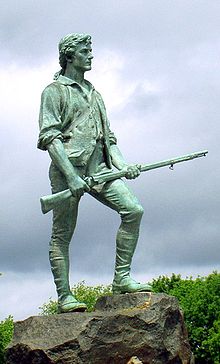
Minute Man Statue, Lexington
Photo source: Wikipedia
The tragic shootings in Colorado this weekend have predictably reopened the national debate about gun control. Nanny Bloomberg suggested that police go on strike until tougher gun laws are in place. Former Seinfeld star Jason Alexander tweeted for a ban on “assault style weapons.” “What purpose does an AR-15 serve to a sportsman that a more standard hunting rifle does not serve?” Mr. Alexander asked. “They are not the same as handguns to help homeowners protect themselves from intruders. They are not the same as hunting rifles or sporting rifles.”

But the Founding Fathers didn’t codify the right to bear arms in the Constitution to preserve our right to shoot deer and protect our flat screen TVs. They did it because they had just overthrown their government by violence, they thought it was a good thing, and they wanted to make sure their descendents could do the same if there were ever again “a long train of abuses and usurpations.” That this was how they thought is clear from The Federalist #46, where James Madison wrote, “Besides the advantage of being armed, which the Americans possess over the people of almost every other nation, the existence of subordinate governments, to which the people are attached, and by which the militia officers are appointed, forms a barrier against the enterprises of ambition, more insurmountable than any which a simple government of any form can admit of.”

In Mr. Madison’s day, the cutting edge of weapon technology was the muzzle loaded rifle. Adapting his reasoning to today’s weapons raises more questions than it answers. The consequences of a civil war - or of a lone madman - are far more horrific than they were in the eighteenth century. Is the goal to ensure that the people and the states (Mr. Madison’s “subordinate governments”) have military superiority over the federal government? If so, is it necessary, in Mr. Alexander’s words, to permit us to “all run out and purchase a tank, a grenade launcher, a bazooka, a SCUD missile and a nuclear warhead?" I suppose you could make the argument – if you’re not one of the people involved – that an occasional Aurora massacre is a reasonable price to pay to maintain our freedom. It’s impossible to make the argument that the occasional destruction of a city in a nuclear firestorm is reasonable.

Is it still possible and desirable to arm our people well enough to keep the feds at bay? And if not, what’s the “barrier against the enterprises of ambition” of the federal government?

Friday, July 20, 2012

Big Nick’s Ride: please support military families and wounded warriors

This weekend, bikers will rally on Cape Cod in memory of Corporal Nicholas G. Xiarhos, USMC, who was killed in battle in Afghanistan on July 23, 2009. Big Nick’s Ride for the Fallen is a 35-mile, police-escorted, motorcycle-only procession from the Barnstable County Sheriffs' Correctional Facility in Bourne to the Flax Pond Recreation Area in South Yarmouth. The ride will pay tribute to those who gave the last full measure of devotion for our freedom. It will also raise awareness of the Nicholas G. Xiarhos Memorial Fund, which supports local military families in need of financial assistance and wounded warriors and their families.

Kickstands up at 11 am, Saturday, July 21. Please support this worthy cause.

  • For more information about Big Nick’s Ride, see www.ngxride.com.
  • For more information about the Nicholas G. Xiarhos Memorial Fund, see this write-up. Donations may be sent to the Nicholas G. Xiarhos Memorial Fund, c/o Citizens Bank, 1116 Main Street, Route 28, South Yarmouth, MA 02664